Monthly Archives: April 2017

Learning Welsh

I’ve recently been toying with a vague idea of learning Welsh. To put this into perspective, it’s one of a long line of vague ideas to do things which I have had over the years. Do not be surprised to learn, in ten years time, that I still have the same vague idea.

Actually, after reading my list of medical adventures, you may be surprised to see that I am thinking that far into the future. I don’t blame you for that, as I did nearly write “five” and “next year” before deciding to use the power of positive thinking.

After reading a couple of translations of the Hedd Wynn poem I became interested in knowing which translation was more true to the original. There are two here and another one here. At that point I used Google, which produced a version that fitted in with the translations. As time has gone by I’ve started thinking I really out to do better than Google. There are internet language courses, so my only excuse is indolence.

I’ve made a start with some road signs.


I’m clearly going to have to expand my vocabulary if I’m going to make any inroads into translating poetry.

Apart from sloth my only other problem is that Welsh is the most foreign language I’ve ever seen written in the Roman alphabet. It’s even more foreign than languages written in the Greek or Cyrillic alphabets.

In fact, the more I read about Welsh, its dialects and its counting system, the more I feel that it may be beyond me.

A Tale of Tubes and Tears

The last few days have not been great, though due to the magic of blogging you won’t know that. When you’ve been reading about the trip to Wales I’ve actually been in hospital in Nottingham. On balance, despite the unpleasantness of a stay in male urology, I prefer Nottingham. There were no Kites, and no bilingual road signs, but the food was better and there was no problem with finding a toilet when you wanted one.

However, as a consequence of the operation and the bad night that followed I’m feeling subdued and tired, so I’m taking the easy way out and talking of hospital rather than Wales.

I quite enjoyed the first part of the visit, though I really don’t like spinal anaesthetics – being stabbed in the backbone isn’t my favourite procedure and I’m not fond of anything that involves putting my feet in stirrups whilst men with beards mess around with urological equipment.

The operation was OK, and being awake allowed me to watch what was happening and talk to people. The recovery room was also quite fun, and the nurses on the ward were very cheery. I even arrived on the ward in time for lunch (fish and chips followed by apple pie and custard).

They even, to look on the bright side, fitted me up with a personal toilet system. It has taken care of the problems I had with passing water, and it means that I can no longer be caught short as I have all I need strapped to my leg.

I was horrified at first when they told me I was going to have a catheter for 6 weeks, partly because it’s the sort of thing that only happens to old men, and partly because I was hoping to have everything fixed up in one go. It seems they want me back in six weeks to tidy things up and remove some stones from my bladder. Typical NHS, you go in for help with one problem and come out with another.

Tea (served at 5pm) was tomato soup followed by  leek, chicken and ham casserole with mixed veg. I had the tinned fruit for dessert to try and increase my intake of fruit and veg. You don’t really get enough fruit and veg in hospital, which is strange (a) because it’s healthy and (b) because nurses are obsessed with asking about bowels.

The food was excellent, far better than when I was in 12 years ago. It was hot for one thing, which wasn’t always the case last time.

I could do a post on hospital food, and may well do that later. I won’t, however, dwell too much on catheters. I can be quite amusing on the subject, but it’s really more suited to the rugby club crowd rather than the sophisticated readership of WordPress.

No pictures today – there wasn’t much that was suitable to photograph.

Trawsfynydd, Toilets and Serendipity

Sometimes things just fall into place.

During our visit to Wales we dropped into Dolgellau looking for a toilet. We found one without too much trouble but, as described, they were locked and barred lest villainous visitors from afar should try and use them after 6pm.

That left us with two choices, one of which was to stroll across the  car park to a restaurant which offered steaks and, presumably, toilets. It also offered the sight of a man in chef’s whites standing outside smoking. We decided not to disturb him.

We therefore left Dolgellau and set off for Bangor with a sense of purpose. When the sign for Trawsfynydd cropped up, complete the WC on it,  I was so surprised that I missed the first turn. My excuse is that the sun was in my eyes. The same happened in the village as I missed the turn for the cat park. After turning round we saw a statue in the Chapel grounds, with the name Hedd Wynn on it.

We’d seen several statues during the day and every time Julia had asked if  I knew who the subject was. She didn’t ask this time. But I told her all the same.

Hedd Wynn was the bardic name of Ellis Evans, a shepherd. He won his first Eisteddfod at Bala in 1907 and ten years later after winning more local competitions he won the National Eisteddfod in 1917. Unfortunately the date, 1917, holds a clue as to why he won no more competitions.

I’ve only read one of his poems, though there are several transactions available on the net. I suppose that’s why he isn’t better known, and why I’ve never seen him an anthology.

He was killed during the 3rd Battle of Ypres, on the same day as Francis Ledwidge, an Irish war poet.

If you check the above links, you will find a fascinating story.

It’s tempting to suggest that if he’d been English, and an officer, people would have taken more notice of him. Of the 16 war poets listed on the plaque in Westminster Abbey, 12 are officers, and if memory serves, all 16 are English.

The Welsh Toilet Championships

It’s not an exhaustive list of toilets, and we didn’t have clipboards with us but it gives you some idea of the challenges the traveller faces.

Those of you under 40 will probably wonder why this sort of thing is important. I won’t explain it now, just give it a few years and all will become clear.

We used the facilities in two McDonald’s, at Llandudno and Mold. They were both bright and clean, though we did feel we had to buy drinks to justify using them, which was sort of counter-productive.

In Rhayader we used toilets in a car park by the town centre. They were very welcome after a long drive, though architecturally there was more than a suggestion of military bunker about them. However, they were clean and tidy, and that’s more important than being aesthetically pleasing.

The toilets at Gigrin Farm, were predictably excellent, as was the whole farm and Red Kite feeding experience.

In Trawsfynydd, just off the road as we travelled to Bangor in the evening, we were glad to find toilets as things were getting a bit urgent (see my comments on Dolgellau). As with Rhayader, the building is stark, but clean and tidy. There was a touch of serendipity about the visit, but that’s a story for a later post.

I think I may have mentioned the lack of decent food outlets at the Bangor Services. We had breakfast at Little Chef and, as you may have predicted, visited the facilities afterwards. I seem to be turning into a Victorian there, as “used the toilets” seemed suddenly unacceptable. They are nicely tiled, but badly maintained and not very clean. Judging by the dirt and graffiti the cleaner only inspects the cubicles with the doors open. That’s basic cleaning, close the door, turn round and look at things from the customer’s’ point of view. Literally. Then wipe the part of the wall that is covered by the open door and wash the graffiti off the back of the door.

RSPB South Stack, was excellent in many ways, which will be detailed in a later post. However, the gloomy, cramped and smelly toilets (sorry about that, but there was no nice way to put it) were a low point in the visit.

OLYMPUS DIGITAL CAMERA

Tourist sign in Llandudno

So that’s it. Clearly South Stack and Bangor Services aren’t in the running.

McDonald’s and Gigrin are all commercial operations, so you expect a higher standard . This standard was met, as they were all excellent, but it seems unfair to compare them with council toilets.

That leaves Rhayader and Trawsfynydd. If I was standing on stage opening an envelope the award would go to Rhayader, as I don’t have a clue how to pronounce Trawsfynydd. To be fair I don’t have a clue how to spell it either, I’m relying on cut-and-paste.

Whilst I think of the final result I’ll mention the toilets at Dolgellau.

I can’t tell you how good they were because at just after six in the evening they were locked. And barred. Maybe they have gold fittings. Or maybe they just don’t like visitors. It’s not unusual to find toilets locked in the evening, but it is frustrating.

There’s a website listing the public toilets of Gwynedd, and if you follow a link on that site the are details of community toilets made available for public use by the owners.  If you are travelling in the area it might be useful.

And the winner is…

… Rhayader.

It’s just a little brighter than Trawsfynydd, which will be getting a mention in a later post.

So, give them a try and see the kites – it’s a good day out.
They promised me Ravens

We went to Wales today. Derby first, then Burton, Lichfield, Cannock, Telford, Shrewsbury…

Didn’t actually see any of them as the roads now just take you past instead of through them. If they didn’t, we’d still be travelling. The road follows a lot of the Watling Street route. This was originally a grass trackway used by the Britons. The Romans paved it and subsequent generations of academics have argued over its route.

It may have gone to Preston, it may have gone to Holyhead. Who cares? They are both nice places and have roads that go to them. For now, let’s say that if you are on the A2 in Kent or the A5 in the Midlands, you are part of a travel tradition going back thousands of years.

In AD 60 or 61 Queen Boudicca, or Boadicea, if you prefer the old-fashioned way, faced the Romans somewhere along the road. Nobody is quite sure where (there are several possibilities) but after burning London, St Albans and Colchester, and killing an estimated 70 – 80,000 Romans, she was finally defeated.

We then struck out into Wales, where we visited Rhayader before travelling up through Snowdonia to Bangor. We’re currently sitting in the Bangor Travel Lodge drinking Aspall’s Suffolk Cider from plastic glasses after a meal from Burger King. Tomorrow I am intending to send a stinging rebuke to the Travel Lodge head office.

The details clearly state: “Guests can enjoy a variety of food and drink choices within easy walking distance from this hotel. ”

Translation: “There is a Little Chef (which closes at 8pm), Burger King and shop at the filling station.”

It’s not quite what I was expecting.

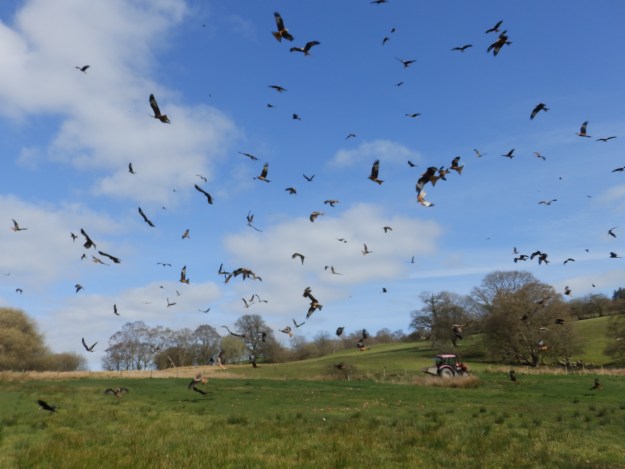
Anyway, the bird watchers among you will have stopped at Rhayader. It’s the home of Gigrin Farm, where they feed 300 to 600 Red Kites every day.

P4040065.JPG


I’ll post a few photos to give you a flavour of the day, but most need some cropping as I has to hold back on the zoom to give myself room to keep the birds in the frame. If you crop it too tight the bird flies out of shot. I have photos of grass, photos of sky and photos of tail feathers.

P4040102.JPG

I’ll tell you what I don’t have – photos of Ravens.

They promised me Ravens and I had to make do with 300 Red Kites.

Sometimes you have days like that.

P4040267.JPG


A Day in Derbyshire

We dropped Number 2 son off in Sheffield after lunch and took a trip into the Peaks. It was a lovely day, the verges were full of celandines and wood anemones in the appropriate places and all was right with the world, apart from one thing. For some reason whenever we say something worth photographing there was nowhere to park.

I’m not saying Derbyshire County Council has designed the road system to stop drivers taking photographs but if they ever decide to do so it will be difficult to improve on the current situation.

Despite this I did manage to get some shots of scenery, or fields and rocks, as Julia pointed out. With a bit more enthusiasm I could have parked and walked a bit more, but that would have meant spending less time at the Brierlow Bar Bookshop.

We’ve been there before, as regular readers will know. The tea is still up to standard and we had some very acceptable cashew and banana cake (though it was a little rich, even for me). I think my new healthy diet might be blunting my ability to appreciate cake. It’s a stiff price to pay, even for a few extra years of life.

I’m afraid a high price has also been paid by the book stock. The Nature section doesn’t seem as strong as it used to be, and the Poetry section seems to be depleted, although my other favourite sections seem either the same (History) or expanded (Crime Fiction). Julia says the Craft section is much smaller too. I like tea but I like books too. I am conflicted.

I suppose I should have bought a guidebook to the Peak District to address my ignorance but I bought one on stained glass, one on War Poets and one about an archaeologist who solves murders.

That’s why there’s a lack of information on Lead Mining, sheep and Blue John in this post. In future posts I will try to address this failing.


Me, moaning about computers and photographing birds

It’s been a strange Sunday. Julia’s laptop has been playing up and refusing to connect to the internet so we went to the computer shop where they told us it would cost £60 to have it sent away, after which they would tell us how much it would cost before we could get it back. Forgive my cynicism but that seems to me to be a good description of how kidnappers operate.

That’s how I ended up looking round Curry’s/PC World looking at new laptops.

It’s also how I ended up sitting in the car whimpering. It’s been an expensive couple of weeks, and the process of spending money

I’m sure it must be possible, bearing in mind the advance of technology and the economics of mass production, to build an acceptable laptop for around £150. We don’t need a terrabyte of memory or the ability to use huge amounts of graphics. We just want to write emails. surf the net and brighten up a few photos.

That’s before I even start on the evils of the new way of selling Microsoft Office. If you own a copy and haven’t replaced your computer in the last few years you’re in for a surprise. You don’t own it now, you just rent it for a year at a time. When your subscription expires you don’t have access to Office.

That’s like buying a car and only renting the ignition key.

After that I had to go to the park and photograph birds.


Bombardment, Bones and Captain Cook

We decided to give Whitby another look on the way back from Sandsend. There’s a lot to see in Whitby and we decided to have a look at the Captain Cook statue and the whalebone arch on the West Cliff.

The first thing we saw was the Bombardment Garden, which commemorates the East Coast bombardment of 16th December 1914. On that day two groups of German warships sailed down along the coast and attacked the towns of Scarborough, Whitby and Hartlepool. One group attacked Scarborough, killing 18 people, before steaming up the coast and killing three more in Whitby. The other group attacked Hartlepool, killing over 100 people.

To be fair to the Germans they were attacking military targets -they shelled a naval radio station at Scarborough and the railway at Whitby. At Hartlepool they engaged shore batteries and the Royal Navy.

The garden represents a house destroyed by a shell.  The shell in the middle of the living room floor is a proper WW1 shell that was given to the town for fund-raising during the war and donated to the project by the town council.


Just along the cliff is the statue of Captain Cook. He was born at Marton, which is now part of Middlesbrough, lived at Great Ayton, was apprenticed to a haberdasher on the coast in Staithes and finally ended up in the Merchant Navy at Whitby. He first came to official notice for his service in the Royal Navy when his charts of the St Lawrence River helped General Wolfe to take Quebec. This led to him being selected to make his famous voyages of discovery, with a certain William Bligh acting as his sailing master on the third and final voyage.

Despite his great achievements he is little more than a cycle rack and seagull perch these days.


The third thing of note on the cliff top is the whale bone arch. Whitby was a major whaling port and between 1753 and 1837 the Whitby fleet accounted for 2,761 whales, 25,000 seals and 55 polar bears.

The inventor of the Crow’s Nest (William Scoresby) came from Whitby and used to be commemorated by a modern sculpture (now replaced by a war memorial). His son, also William Scoresby, was, like his father, a whaler and arctic explorer, but also a scientist and priest, who was quoted by Ishmael in Moby Dick.

The original arch was set up in 1853 to signify the importance of whaling in Whitby’s history. That set lasted around a century and were replaced by a set from a Fin whale donated by Norwegian whalers. They only lasted until the 1990s, when their replacement caused a certain amount of ethical concern. One suggestion was that there might be some bones preserved in the cold of the Falklands. In the end Whitby’s twin town of Barrow in Alaska came to the rescue with a set of jawbones from a Bowhead whale killed in a legal hunt by Alaskan Inuit.

I don’t know what I’d do if I was in charge of the whalebone arch. Fibreglass and plastic have been considered but dismissed, which I think is fair enough, but I’m not easy with the idea of using real bones, even if they are legally taken. I think I’d opt for a nice stainless steel sculpture.

Or a plaque saying that there used to be whale bones there but we have moved on.