Category Archives: History

The Carus Brothers at War (Part 2)

I didn’t really know anything about the rest of the Carus family – my Grandmother had been brought up by her mother’s family after she was orphaned and her uncles had all  died before I was born.

Using census records I was able to reconstruct the family – Susannah (b 1872), Thomas (b 1876), Isaac (b 1879), Walter (b 1882), Albert (b 1884), Harry (b 1887) and Charlotte, who seems to have become Margaret (b 1890). I must spend a few minutes sorting out her details. There were also three children who died in the gaps between censuses. In the 1911 census they asked how long a couple had been married, how many children they had had and how many of the children were still living.

30850_A000296-00834

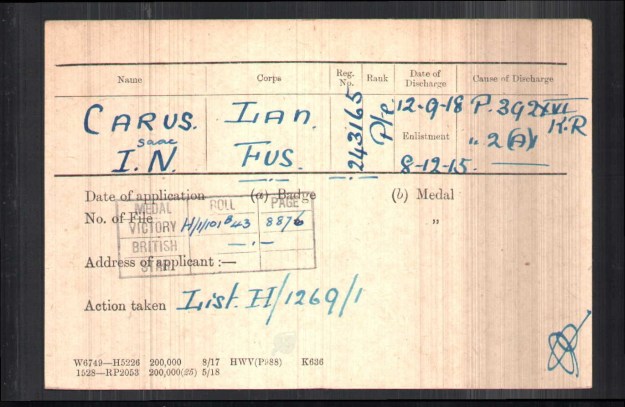
Because Isaac was Isaac Newton Carus and Walter was Walter Dugdale Carus, which were both distinctive, I checked them out through the army records – there were only 16 entries for Carus in the medal record cards so I thought I had a good chance. Isaac N Carus popped up – entitled to the British War Medal and Victory Medal with the Lancashire Fusiliers. There was a note on his card that he had enlisted on 8th December 1915, several months before conscription, and had been discharged on 12th September 1918 under King’s Regulations 392 xvi. This is a catch-all regulation – “No longer physically fit for service”. It could be through wounds, disease or other causes. The next step was to check what they call the Silver War Badge Roll – it provides the additional information that I N Carus served overseas, was 39 on discharge and was issued with badge number B6.

wo329_3077-00072

The Silver War Badge was first issued in September 1916 to servicemen who had left the service for a variety of reasons and was meant to show that they were not shirkers, deserving of a white feather. The first 450,000 men were given badges with no prefix, then they started the badges with the B prefix. Great Uncle Isaac was 6th on that list.

That was where I had to leave Isaac for the time being.

I was, however, able to pick him up quite easily when I took a look at the papers as he was the first Carus reference to come up. He died in Blackburn Royal Infirmary on 17th May 1947 at the age of  68. He is called “one of the best known Clitheronians” and had been badly disabled after being wounded with the Lancashire Fusiliers in 1917.

He worked as a printer, ending up with the Clitheroe Advertiser, but had to retire in 1925 due to his war injuries. He was active in the Oddfellows, the Weslyan Church (a Sunday School teacher for over 20 years) and the cricket club. He played football in his youth and was a regular in the cricket team (mainly as wicket keeper for the seconds) until his wounding, after which he became scorer and joined the committee.

He was survived by his wife, two sons and two daughters. The sons both served in the Second World War and survived to play in many post-war cricket matches.

Unfortunately I have no photographs, but am working on that.


The Carus Brothers at War (Part 1)

I just took out a subscription to an internet newspaper archive last week and the first task I set myself was searching for some family history. With one branch of the family it has come up trumps.

You may have heard some of this before as I have mentioned it and have used the photographs before. Sorry for the repetition but with new information, and it being exactly 101 years to the day since his death, I thought it was worth another post.

I have many common names in the family but am fortunate in having one branch with the name of Carus. To make things better, they come from Clitheroe – a small town with its own newspaper.

Harry Carus (1887-1916) was my great grandfather. When I started researching him I knew that he was one of a large family, that he’s on the Clitheroe war memorial and that he left a wife and three daughters when he died. He was a chapel-goer, Sunday school teacher and member of  a self-improvement club called the PSA (I believe that’s Peaceful Sunday Afternoon). He joined up as a volunteer and, on his last leave before going to France, laughed when his irate wife discovered that the three girls had found, and mostly eaten, the special cake baked for his last visit.

It had been on a top shelf in the kitchen and my grandmother had climbed up the lower shelves like a ladder before passing down to my Auntie Peggie – second in age and partner in crime.

The Commonwealth War Graves Commission gives the information that he died on 10.10.16. He was a Corporal, aged 28, belonged to “B” Battery of the 180th Brigade
Royal Field Artillery. He was the son of H. A. and Margaret Carus, of 27, West View, Clitheroe, Lancashire and husband of the late Ellenor Carus.

This was during the latter, rainy, part of the Somme battle and was probably every bit as hellish as we imagine the First World War to be.

He has no known grave and is commemorated on the Thiepval Memorial, the iconic arched memorial that lists the names of  72,396 Somme casualties who also have no known grave. In a later post I may well come back to the phrase “no known grave” as it’s an interesting subject in itself.

As more details became available from the release of records I was able to learn a little more about him.  He had four brothers and two sisters, worked for a grocer and his last known address is still standing. I have visited it using Google Maps.

The army medal rolls show that he went to France on 28.11.15 and is entitled to the 1914-15 Star, War Medal and Victory Medal. They spell his name “Carns”. His family was also given a bronze commemorative plaque and a scroll. On the subject of names, his wife was Eleanor, so even CWGC aren’t perfect.

When I searched the newspapers I was able to find the memorial notices posted a year after his death, and pin down a couple more family addresses. The family was still together in those days – the remarriage and death of Eleanor  and the separation of the girls was still to come, as Harry’s death continued to affect them in the coming years.

I was also able to find a mention of his death in the “25 Years Ago” column, when it was noted that he had been in a gun pit with six others when a shell landed in it and killed five of them. Presumably this was what had been contained in a letter at the time of his death – my grandmother had always said he was hit by a shell that killed him instantly and left nothing for burial. It’s nice to have corroboration but I’m not sure it’s true, it was just what people wrote home to parents and widows to hide the truth.

That, in a nutshell, is the life and death of Harry Carus.

Poppies

Roadside Poppies

Thoughts of Mayors and Medals

I thought it was time for more from the junk box. We’ve covered coronation medals and other commemoratives so here is something a bit different.

This is a fund raising medal issued by the Borough of Newark to raise funds for the families of soldiers who fought in what they refer to as the Transvaal War, now generally known as the Boer War in the UK, though they have other names for it in South Africa. I won’t discuss the Boer War here, as it will take a lot of space and reflects no credit on the British.

As you can see, it is one step beyond the junk box and appears to have been buried at some point. It also looks like someone has attempted to put a hole through it at the top, probably to use it as a watch fob or wear it on a ribbon.

OLYMPUS DIGITAL CAMERA

Newark  Fund Raising Medal 1900 (Reverse)

They originally cost a shilling, with silver ones costing five shillings and a case costing sixpence extra. There were 12 pennies in a shilling and 20 shillings in £1, in case you are a decimal baby.

As you can see from a careful look at the picture, they were made by Vaughtons of Birmingham.

It is the local equivalent of the Absent Minded Beggar medal, part of a massive Boer War fundraising effort.

The war served as something of a wake-up call to the British, when they got the runaround from a bunch of farmers. This meant that we called for volunteers and found that one in three was rejected due to the effects of poor diet. This would lead to the Education (Provision of Meals) Act (1906) because properly fed citizens were needed for the services. I would have thought it was counter-productive as fatter soldiers make bigger targets, but I suppose they need to be strong enough to march and carry things.

There’s a picture of F H Appleby here, with a truly inspiring soup strainer moustache, with further details here. He really was a busy man.

The spiritual descendent of this medal is the current Newark Patriotic Fund, which helps ex-servicemen and their families.


More From the Junk Box

The top picture is a lapel badge issued on Nottingham Warriors Day in 1921. It took place in March 1921 and was to raise funds for the Earl Haig Fund. There were a number of events, including a matinee performance that raised £400 for the fund and it was supported by the Prince of Wales, later Edward VIII. He was popular in those days.

This would later be eclipsed with the launch of poppy sales on Armistice Day 1921 – £106,000 raised in just one day.

Poppy seeds can lie dormant for many years. People used to say 90 years but now we are in the centenary years of the Great War they tend to say one hundred. It’s possible that poppies blooming today were seeds in 1914-18.

Try this for a less sentimental view of poppies.

After many references to sports teams, martial arts and eco-warriors I finally found references in a newspaper archive. I knew most of it, but when you are about to tell people from all over the world you really need to check your facts.

Most of the links just proved that like “hero”, the word “warrior” has been devalued over the years. Playing rugby for Worcester or recycling your newspapers should not qualify you for the title Warrior. On the other hand, the ironic use of keyboard warrior does meet with my approval, and yes, I admit I can be one myself.

Moving on to 1928, we have a medal for the opening of the new University buildings by George V and Queen Mary on 10th July 1928.


We then move on to 1935, the Silver Jubilee of George V and Queen Mary. This medal, as you can see, was given out by the Nottinghamshire County Council Education Committee. I presume it was given to school children. In a Lancashire my parents were given mugs, which they used to display in a cabinet when I was a kid. They are wrapped up in a box now, When I die I expect my kids will sell them. I don’t blame them. A fascination with the detritus of past times is not for everyone.

You may notice that the coat of arms looks a bit like it’s been designed by a child with a handful of crayons. It was replaced in 1937 by a proper one. I quite like the old one but as coats of arms go I have to admit the new one looks more traditional. I can’t find more details at the moment.

One thing that could have done with a medal is the opening of Gunthorpe Bridge on 17th November 1927 by the Prince of Wales. Yes, him again. Nobody seems to have bothered, so we just have to make do with a plaque on the bridge. One day I might stop and take a picture. One day when I am past caring about being squashed by a lorry.

Once you cross the Trent at Gunthorpe, the next crossing is Newark. I’ll leave that for the next post.

Bicycles and the Military Cyclists

Today, the image of soldiers on bicycles seems incongruous, but in the late 19th century we were not blessed with quite so much technology. We take personal transport for granted, but at this point in history you either walked or, if you were rich enough, used a horse. Bicycles, in their way, were a quiet revolution.

The earliest cycle design dates back to 1534 when Caprotti, a pupil of Leonardo da Vinci, sketched a design. The first modern cycles, without pedals, were used in the early 19th century and pedals appeared in 1863. The Scots were at the cutting edge of bicycle design at that time (a fact I throw in for Tootlepedal). Designs moved on to the “ordinary” or “penny farthing” design.

Thomas Stevens used a penny farthing on his trip when he became the first man to ride round the world on a bicycle in 1884-6. Annie Londonderry was the first woman to travel round the world with a bicycle, in 1894-5.

The first British military cyclists to see action were the messengers attached to the Jameson Raid in 1895-6. They appeared again during the Second Boer War of 1899-1902, when one unit was equipped with specially adapted tandems to ride along railway lines and guard them from sabotage. Both sides used bicycle troops as couriers, scouts and raiders.

Unlikely as it may seem to a generation that needs four wheel drive to cross open country, bicycles were seen as the solution to moving quantities of troops rapidly across open ground and in Switzerland they were able to travel on terrain that horses could not. With a network of roads available to them bicycle troops were seen as cheaper, quieter and easier to train than cavalry.

Both sides used bicycles in the Great War and they were also a feature of the Second World War (the Japanese using 50,000 bicycle troops in Malaya),  Vietnam and the Tamil Tigers’ uprising in Sri Lanka. The Swiss disbanded their bicycle troops in 2001, whilst the Sri Lankan army still has bicycle troops.

At the beginning of the Great War the British Army had 14 battalions of bicycle infantry ready for use. Many were used on coastal defence in the UK, and others served on the Western Front, though they were not particularly useful until the resumption of open warfare at the end of 1918.

Although this may not seem like good value it was at least as effective as the cavalry, and bikes, unlike horses, didn’t need food or stables and didn’t produce manure.

OLYMPUS DIGITAL CAMERA

Painted enamel brooch of the Northern Cyclists – about three times life size, which is why some of the detail looks a bit blurred.

The Kent Cyclists served on  the North West Frontier during the war and, along with the 25th (County of London) Cyclist Battalion served in the Third Anglo-Afghan War.

The 2/10th (Cyclist) Battalion, Royal Scots (Lothian Regiment) served in the North Russian campaign.

The Army Cyclist Corps was disbanded in 1920 and all the units were redeployed by 1922.

OLYMPUS DIGITAL CAMERA

Sweetheart brooch of the Huntingdonshire Cyclist Battalion. They spent most of their war guarding the Yorkshire coast. The fact that it is still there speaks highly of their efficiency and a job well done.

History in a Junk Box

There was a time when dealers used to have junk boxes full of clapped out coins, broken bits and base metal medallions. I certainly did. When I bought mixed boxes at auction the detritus from the bottom, after being carefully checked, would end up tipped in the junk box.

When buying, the junk boxes of other dealers were my natural habitat. I’ve bought some good stuff out of junk boxes. It seemed like they would never end. Then ebay came along and  it all ended up on line.

The contents of the box could cover anything from ancient coins to petrol station giveaways, via Georgian medals, Victorian adverts and pre-decimal coins. One of the staple items was the mass produced commemorative medal. They really started in a big way with Queen Victoria’s Golden Jubilee in 1887 and ended in the 1930s with a flurry of royal events – George V’s Jubilee, the abdication (though this is shown only by the  items of Edward VIII (which aen’t really rare, whatever dealers may say) and, finally, the coronation of George VI.

This is the medallion Nottingham produced for the 1897 Jubilee of Queen Victoria

This is the Edward V!! medal from Nottingham – note the foresters supporting the coat of arms.

The colour changes for 1911, as do the supporters on the coat of arms, but the general idea remains the same. There is a second version of the medal, often known locally as the unofficial version (see below).

There is a medal very similar to the 1911 coronation medal – made for the 1914 Royal visit. It isn’t just in recent years that the Royal Family has been unpopular, there were seven attempts to assassinate Queen Victoria and one on Edward VII. In 1914, to encourage public approval George V embarked on a programme of visits. I’ve seen the itinerary for his visit to Nottingham – he visited Arnold and Mansfield too, though I think he just waved at Arnold in passing.

Royal visit to Nottingham (above( and Dundee (below).

Things seemed to tail off after that, with a much smaller selection being produced for 1953. To set it in perspective, rationing was still in force in 1953, and the fledgling Matchbox company struggled to produce model cars when metal supplies were diverted to fighting the Korean War.

This is one of the later medals, from Mansfield Woodhouse.

I have plenty more to show you yet, so don’t worry about me running out for the next few weeks,

When Did Grey Become a Colour?

I’ve noticed a growing trend over the last few years, particularly in village gastropubs, to paint pubs and restaurants in shades of grey. Recently I’ve even noticed houses being painted grey. My father tells me that when he was an agricultural rep in Yorkshire during the 1950s grey was a very common colour for farms. This state of affairs came to an end once the stocks of wartime surplus battleship grey came to an end, though some farmers still use it to this day.

I really should have taken more photos to illustrate the point, but my blogging, like the road to Hell, is paved with good intentions. Fortunately, as we were passing Nottingham’s newest pub this morning we noticed it was grey and Julia snatched a photo through the window.

The word “newest” in this context, means most recently renovated.

After being empty for 10 years the pub formerly known as The Peggers Inn narrowly escaped being known as Pubby McPubface, a trend in public votes that seems to be eternally amusing to some people. It is, as you can see, now known as The Fox and Grapes, the name with which it opened .  This link shows some of the architectural detail, including the fox and some grapes.

It’s being run by Castle Rock Brewery, I thought I’d give it a mention as I quite like Harvest Pale and if they read this they may send me some. They probably won’t, but I just thought I’d have a go. Julia’s niece works there, so it won’t harm to help the company along.

That’s about it for the moment – grey, pub, Castle Rock Brewery. That just leaves the murder.

In 1963 the Pretty Windows murder made the national headlines. As you’ll have gathered if you looked at any of the links above, the pub was generally known as the Pretty Windows and the landlord was brutally stabbed in slightly mysterious circumstances. Why, for instance, was he wearing a suit to walk his dog that night?

The murder, despite the assistance of Scotland Yard, was never solved.

After the photo raid we went home – see here for the Magpies.


Military Sweetheart Brooches

The brooch in the featured image is one of the earlier ones you will see about. It is a hollow silver horseshoe with the dates of the Boer War on the front and a Victorian crown at the top of the badge. It’s actually hallmarked 1904 on the back, but sweethearts can be a bit like that, and aren’t always as accurate as you would like.

The earliest sweethearts date from the 1890s but the first surge of popularity took place during the Boer War (1899 – 1902) then in the Great War things really took off. This is logical when you think there were millions of men in the army, and consequently millions of wives and girlfriends to buy the brooches for.

At this time they also became cheaper and less well made. Brass and enamel sweethearts from this time are very common, as are the ones with plain mother of pearl surrounds.

There were other styles, including ones mounted on rifles and swords (though you’ll have to settle for rifles at the moment as that’s all the photographs I have).

The next step up in terms of quality were the silver rimmed mother of pearl brooches, often stamped “Sterling Silver Rim” on the back. There were also silver badges and silver-rimmed tortoiseshell brooches. The silver ones are often stamped “Silver” or “Sterling” on the back, but the silver rimmed tortoiseshell brooches are usually hallmarked.

These two brooches demonstrate another feature of collecting – the Machine Gun Corps was a war-raised unit and existed from 1915-22. Their brooches are sought after by collectors of Great War memorabilia, despite the fact they shouldn’t be rare –  over 170,000 men served in the corps during the war.

By contrast, the Royal Engineers aren’t a sought after unit as there were so many of them – in August 1917 there were 295,668 men serving in the RE. Despite being common, and made from tortoiseshell, the RE brooch does have a significant advantage over the more desirable MGC brooch – it is hallmarked on the back.

OLYMPUS DIGITAL CAMERA

Hallmarks on the back of the brooch

This allows us to tell that it is sterling silver (the Lion), was hallmarked in London (Leopard’s head) and dates from 1916 (letter a). The maker’s mark “C Bro” is the mark of Corke Brothers and Co.

This is just a brief view of sweethearts – there are other types so, as my photography catches up there may be other posts on the subject.

They have a much closer connection to the men of the Great War than medals, for instance. At least you can be sure that most of these brooches were bought by soldiers and worn by mothers or girlfriends. Sometimes you find one still pinned to its original card, where it has been stored in a drawer for years, but most seem to have been worn.

OLYMPUS DIGITAL CAMERA

Notts and Derby – still on original card

Contrast this with the medals from the Great War. Many, when sold by families, are still in the boxes, having never been worn. My grandfather kept his in a drawer and never showed them to anyone. We all thought that his mother had thrown them out when she threw away his brother’s medals. Having lost a son and a son-in-law, she got rid of everything connected with the war and refused to discuss it until the day she died in 1930. Those who died in the war, of course, never even saw their medals.


Book Review – Eggs or Anarchy

Eggs or Anarchy by William Sitwell

Paperback: 368 pages

Publisher: Simon & Schuster UK (9 Feb. 2017)

Language: English

ISBN-10: 1471151077

ISBN-13: 978-1471151071

Between the wars the government took the view that we should produce what we were good at and import the rest. This meant we were importing about 60% of our food, as we had been doing in 1914. The problem was that the Germans had more efficient aircraft and submarines in 1939.

Fter a successful retail career, Lord Woolton took on the job of sourcing the millions of uniforms needed to equip a new army. He was surprised to find that having ordered the trousers he had to order the fly buttons via another government department.

He managed to sort it all out, and then took on the task of organising food supplies, including issuing millions of ration books and developing a system that was fair to all.

He didn’t just have U-Boats to worry about, he had Churchill and his attempts to use shipping for moving troops. Then he had to organise storage for food in places where it wouldn’t be bombed, make sure our suppliers didn’t overcharge us and iron out inefficiencies in distribution at home. The title refers to the fears that order and morale would break down if he was unable to get the rations out.

One of my favourite moments was when he told visiting American politicians that he would prefer their ships to their good wishes. He was not a conventional politician, having come to it late in life.

As for the famous Woolton Pie… Well, you’ll have to read the book to find out his thoughts on that.

It’s an interesting subject, though the writing doesn’t always reflect this, and poses a few questions about food security, which we are going to have to answer in the coming years.

Garden Centres, Disappointment and a Widow

We  went to two garden centres this morning. The first one was disappointing, with a closed cafe and a definite lack of things worth buying. The second was equally poor, despite promises of 50% off. At least the cafe was open, even if they did serve the cheese toasties with salad on a breadboard. Not even a traditional British breadboard either, but a modern pressed bamboo monstrosity.

Both of them seem to be plagued by thieves, judging from the notices stuck up around the centres. Hampson’s in Wakefield have gone as far as to install a security shed and employ two people to write signs telling you that “Your on TV” (sic), or in the case of the second person “You’re on TV”. I’ve never had the opportunity to write (sic) before; blogging is really expanding my horizons.

P8232089.JPG

Security shed ay the Garden Centre

The garden centre at Ackworth takes a different approach, having a sign up to ask customers to report each other if they see them stealing.

So there we were, with hardly an item purchased, nothing of interest seen and not much of a back-up plan. At that point we found the Ackworth memorial to local quarrymen. I’ve driven through the village dozens of times before Number Two son’s enforced retirement from Rugby League and never knew it existed.

It lists 15 men of the area who died between 1878 and 1935.

I had a quick look for John Desborough on the internet – it’s a reasonably uncommon name and it produces several results. Born in Lincolnshire in 1843, spent some time in Holbeach Workhouse with two brothers and a sister. He was an agricultural labourer until 1876, when he married in Ackworth, worked as a quarryman and had five children before being killied in a quarry accident on 17th  May 1889.

His wife Susanah did not remarry, and his three sons all went to work as quarrymen. Susannah died in 1916, and is buried in St Cuthberts churchyard.

Tough times, and an interesting memorial.