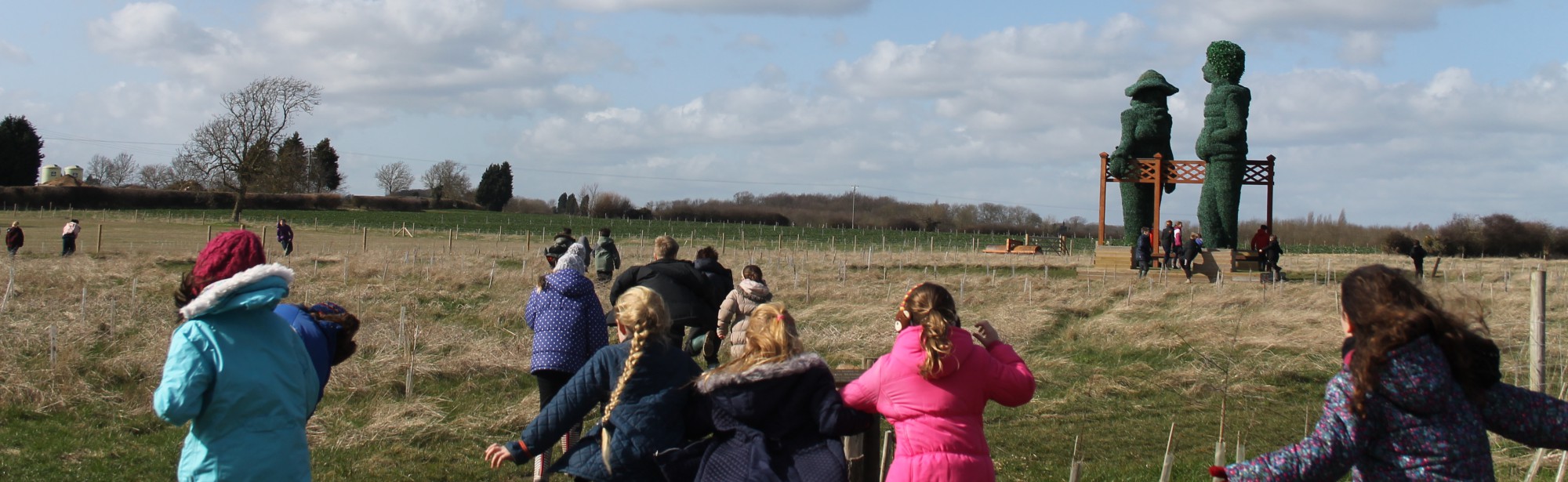

 Cromwell’s statue in St Ives – the Huntingdonshire town, not the Cornish one, as noted on several internet captions. What do they teach them in schools today?
Although these days we tend to think of body parts as something to be treated with reverence, and even something to be returned to the cultures to which they belong, this hasn’t always been the case.
Some of the mistreatment was simply casual, life was cheap, and bodies were not always accorded the respect we now give them. When you see the way living people, including children were treated during the Industrial Revolution it’s hardly surprising that dead ones were treated worse. Old bones were used industrially – the bones of Waterloo were burned for charcoal to process sugar beet, British buyers toured Europe to buy battlefield bones for processing into fertiliser and human teeth from battlefield corpses were reused as dentures. These were actually known as Waterloo teeth – an early form of marketing, though most of the early ones came from other battlefields, or even from executed criminals. George Washington, famously bought nine teeth from slaves. By the latter part of the century there was substantial trade in these teeth – first to the USA after the Napoleonic Wars, then to Europe after the American Civil War released a glut of teeth onto the market.
Some was deliberate, either to make a political point by displaying the heads or body parts of traitors, or by mutilation, preventing entry to the afterlife. This was done to John Wycliffe, the Vicar of Lutterworth in Leicestershire, In 1428, 44 years after he died, he was declared a heretic, his body was exhumed, his remains burned and the ashes scattered in the River Swift.

In the Middle Ages many religious relics were used as a basis for an early form of tourism, as pilgrims visited shrines to see the relics, bringing offerings to the church and money to the local area. Peterborough, for instance, had an arm of St Oswald, which brought in much revenue and was guarded by a monk day and night. They were, of course, sensitive to the possibility of theft , as that was how they obtained the arm in the first place. Winegot, a monk from Peterborough, had a dream in which St Oswald’s arm asked him to take it somewhere it would be appreciated, so he stole the arm from Bamburgh Priory some time before 1066. It was later seized by Hereward the Wake, who lodged it in Ramsey Abbey. It was returned when the Abbot of Peterborough threatened to attack and burn the abbey at Ramsey. The Church was very different in those days.
Later, dismemberment, in the form of hanging drawing and quartering, was used as a punishment for treason, and although it seems like something from the distant past it was only in 1782 that the last man in England was executed in this way. David Tyrie was a clerk in the Royal Navy who was tried and executed for holding a treasonous correspondence with the French. They used to nail the body parts to town gates to discourage further crime, though Tyrie was buried on the spot he was hanged. However, this isn’t a history of execution, so I will get back to Cromwell.
Anyway, back to Cromwell’s head. He was a local man (now that I am living in Peterborough), born and schooled in Huntingdon, with links to St Ives and Ely. He stopped a convoy of silver leaving Cambridge for the King at the start of the Civil War, raised a Troop of Horse, which arrived late for the Battle of Edgehill, and embarked on a military career that would see him win numerous victories before, in 1649, taking a lead in the execution of King Charles I and becoming Lord Protector.
On his ascent to the throne in 1660, Charles II took a practical, and generous view, of the events before his Restoration, which was enshrined in law as the Indemnity and Oblivion Act of 1660. The act was a relief to many supporters of Parliament, who were spared punishment, and a disappointment to many loyal Royalists, who were not able to get their property back, even though the lands of the Crown and Church were returned by the act. In all, 104 people were exempted from the general amnesty, of whom 24 had already died (although excluding them did allow the Crown to seize their property). Nor did it save some of them from further punishment. Cromwell, Henry Ireton and John Bradshaw were all subject to posthumous executions, their bodies being dug up and displayed at Tyburn before being beheaded (it reportedly took eight blows of an axe to remove Cromwell’s head). Their remains were cast into a pit below the gallows. Cromwell and Ireton had been embalmed before burial, Bradshaw had not, a point that will become important later in the story. The heads were mounted on spikes which were fastened to the roof of Westminster Hall, where King Charles I had been condemned in 1649. The date of the posthumous beheadings was 30 January 1661, 12 years to the day after the execution of King Charles I.
 Cromwell’s statue in St Ives, Huntingdonshire. In 1932 several local lads attached a yo-yo to the finger. In my youth I knew two of the miscreants. They claimed it had been a sensation in its day and had made the front pages of the papers. A search of the archives suggest it was not quite so newsworthy.

Cromwell’s son Richard, who succeeded his father as Lord Protector, was not, it may surprise you to learn, punished after the Restoration. He spent around 20 years in voluntary exile in Europe, but returned to England, where he lived in Hertfordshire until his death, at the age of , in 1714.
Ireton had tenuous local links – being Cromwell’s son-in-law and being responsible for building a military road across the Fens, now part of the A142 between Mepal and Chatteris – still known as Ireton’s Way. Another regicide with local links was Valentine Walton, Cromwell’s brother-in-law. He came from Great Staughton, near Huntingdon and fled the country at the Restoration, dying in Flanders in 1661 whilst working as a gardener.
Cromwell’s head, bound in iron, stayed in place until a storm in 1684 blew it down, where a sentry found it on the ground and took it home. A reward was offered for the return of the head, which was considered a significant national relic but it remained hidden until 1710, when it was displayed in a private museum in London. The owner, Claudius du Puy, claimed it was worth 60 Guineas at that time, about £12,000 today.

In the late 18th Century, the head was in the possession of Samuel Russell said to be a descendent of Cromwell and “a failed comic actor and drunkard”. He sold it to James Cox (1723-1800), a jeweller, and maker of automata, in 1787. Cox was an interesting character who, at one time, had his own museum. He appears to have pursued Cromwell’s head for many years and was only able to buy it after closing his museum, so he never displayed it. His most famous creation is The Peacock Clock, which was built for Catherine the Great and is still on display in the Hermitage Museum.
Cox paid £100 for the head, about £14,000 when adjusted for inflation. He sold it in 1797 to the Hughes brothers, who were putting together a collection of Cromwell memorabilia for display in Bond Street. It cost them £230 (about £25,000 when adjusted). Their exhibition was not a success, partly due to gaps in the provenance and the resulting rumours that the head was a fake.
The fact that there were two “Cromwell Heads” in existence didn’t help, though as any student of relics can tell you, this is not unusual. Both St Oswald and St John the Baptist, have had their supposed heads on display in four different churches at the same time.

It was said, by John Cranch, who promoted the exhibition for the Hughes brothers, that Cromwell’s was “the only instance of a head cut off and spiked that had before been embalmed; which is precisely the case with respect to the head in question”. This was, in general, true, as traitors were normally executed while they were alive and unembalmed. Unfortunately, Ireton’s body had also been embalmed before execution, leaving room for doubt. A letter from John Constable in 1799 says
Smith’s friend, Clanch has left off painting, at least for the present. His whole time and thoughts are occupied in exhibiting an old, rusty, fusty head with a spike in it, which he declares to be the real embalmed head of Oliver Cromwell. Where he got it, I know not.; ’tis to be seen in Bond Street at half a crown admittance.’
It passed to the Wilkinson family in 1815 and remained in their possession until 1960. It was examined several times over the years, notably 1911 and the 1930s, as was the other head in the Ashmolean Museum. The Ashmolean head had not been embalmed and the spike had been driven in from the top, so it was clearly a fake.
The other head was authentic, in that it had been embalmed after death but before beheading and the spike had been driven up from below. The spike (seen in the picture of the Wilkinson head) is from a contemporary pike with the langets (steel reinforcing strips) and remains of the pike shaft being clearly shown.
 Canon Wilkinson with the head
When the head blew down in 1684 it was known to be Cromwell’s as the positions of the heads were known. That was why the reward was offered. Cranial measurements suggested it was Cromwell, though some doubt remained due to the possibility that it was Ireton’s head. In the end, the experts, after compiling a 109 page report, concluded that the head did belong to Oliver Cromwell.
In 1960, the Wilkinson family contacted Sidney Sussex College, which Cromwell had attended, and it was agreed that the college would become the new custodian of the head, which would be buried, rather than displayed to the public. It was buried, in the oak box which had contained it since 1815. The interment took place at a small private ceremony in 1960 and was announced two years later.


